


Generazione Sicilia – The Elenk’art Collection: Loredana Longo and Francesca Polizzi
- Mar 19
- 3 min read
From March 28 to May 31, 2026, the Cittadella dei Giovani in Alcamo (Trapani) presents a new stage of Generazione Sicilia. The Elenk’art Collection, an exhibition project included in the official program of Gibellina Italian Capital of Contemporary Art 2026.

Curated by Alessandro Pinto and Sergio Troisi, the exhibition brings into dialogue the practices of artists Loredana Longo (Catania, 1967) and Francesca Polizzi (Palermo, 1988) within a space entirely dedicated by the municipality to young people, conceived to foster interests in art, music, and science beyond the school environment.
Generazione Sicilia. The Elenk’art Collection, inaugurated in Gibellina last January, is on view at the MAC – Museo d’Arte Contemporanea “Ludovico Corrao” through May 10, with a selection of works from the Elenk’art Collection, alongside an installation by Daniele Franzella in the former Church of Jesus and Mary.
The Alcamo exhibition, staged in the spaces of the former slaughterhouse and municipal depot, now home to the Cittadella, sets the practices of Longo and Polizzi in dialogue, developing a reflection on conflict, memory, and the transformation of matter as a political and symbolic space.
Although belonging to different generations, the two artists share an approach to matter as a field of tension, in which gestures, processes, and signs reveal deeper dynamics connected to history, power, and the intimate dimension of experience.
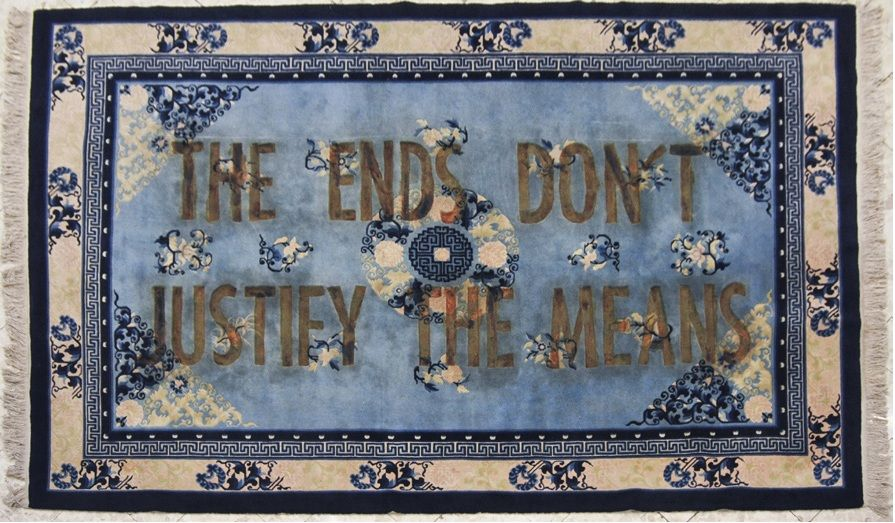
In the project It’s not yet dark / Non è ancora notte fonda, Loredana Longo addresses social, historical, and personal conflict through materials and processes marked by an implicit destructive tension.
Words and symbols of power, such as Victory or phrases by Western leaders burned into oriental carpets, are stripped of their rhetoric and returned as traces of a wound. Through interventions that cut, burn, or break matter, the artist stages the fracture between public space and private dimension, between protection and threat, revealing the tensions that run through our political and cultural imagination.
With the project Beringia, Francesca Polizzi instead develops a research grounded in practices of material transformation and transfer. Materials such as wool, wax, rosin, and resin become the starting point for the construction of unstable sculptural bodies, marked by the memory of the gestures and processes that generated them.
The works create a tension between organicity and structure, permeability and containment: metal exostructures, devices, and reconfigured architectures intervene as elements of support and constraint, defining precarious balances between visibility and inaccessibility, resistance and vulnerability.
The project Generazione Sicilia stems from the desire to recount the evolution of the island’s artistic scene through the heritage of the Elenk’art Collection, initiated in the 1970s by Antonino Galvagno and expanded by Francesco and Silvia Galvagno from the 1990s onward.
Beginning with a nucleus of 19th-century Sicilian paintings, the collection gradually expanded to include 20th-century Italian art and contemporary practices, also embracing important international presences and a plurality of artistic languages. With over 600 works, the Collection now represents one of the most significant examples of private collecting in Sicily and, by virtue of the breadth and rigor of its choices, takes on the value of a museum-like collection, capable of offering a layered reading of 20th-century artistic history and its more recent developments.

The collection brings together leading figures of Sicilian painting, such as Alessandro Bazan, Francesco De Grandi, Andrea Di Marco, and Fulvio Di Piazza, alongside works by Andrea Buglisi, Manfredi Beninati, Francesco Lauretta, and Igor Scalisi Palminteri, as well as artists working across different languages and media, including Francesco Simeti, Loredana Longo, and Daniele Franzella. Special attention is given to younger generations, represented by Dimitri Agnello, Francesca Polizzi, and Roberto Orlando.
Through the exhibitions in Gibellina and Alcamo, Generazione Sicilia presents an active form of collecting, deeply rooted in the local territory and committed to supporting and promoting contemporary research and intergenerational dialogue. Over the past decades, this commitment has also taken the form of ongoing scouting, contributing to a significant mapping of the contemporary Sicilian art scene.


Comments