top of page

After more than thirty years away, Massimo Scolari returns to exhibit in Milan within the historic spaces of the Galleria Antonia Jannone Disegni di Architettura, which last hosted him in 1992.


Shiota Chiharu, Uncertain Journey, 2016/2019
Massimo Scolari, Città Moderna, 1995

Solca Mari Mossi, on view from 19 November to 24 December 2025 with an opening event on 19 November at 6:00 PM at Corso Garibaldi 125, is a dense and rigorous exhibition retracing over half a century of artistic research, from the 1970s to 2020.


The show brings together mostly unpublished oils, watercolors, and etchings, in which two of Scolari’s major obsessions converge: figurative archetypes and mountain architecture—the latter understood as a primal, symbolic, and cosmogonic form. Painter, sculptor, designer, theorist, and historian, Scolari embodies the idea of the artist as poíētēs, the one who “makes”: he paints, builds, designs objects, writes, and shapes entire worlds.


Author of iconic works such as L’Arca (Milan Triennale, 1986), Ali (Venice Biennale, 1991)—a monumental sculpture now located on the roof of the IUAV University in Venice—and Turris Babel (Venice Biennale, 2004), Scolari has also crossed into design with projects for Giorgetti and Alessi, including the Segnalibro and silver-point pencil, awarded an Honorable Mention at the Compasso d’Oro in 1998. In 2014, the American Academy of Arts and Letters honored him with the Arnold W. Brunner Memorial Prize in Architecture for his contribution to architecture as an art form.


Philip Guston If This Be Not I 1945 Mildred Lane Kemper Art Museum. Univerity purchase, Kende Sale Fund, The Estate of Philip Guston, courtesy Hauser & Wirth
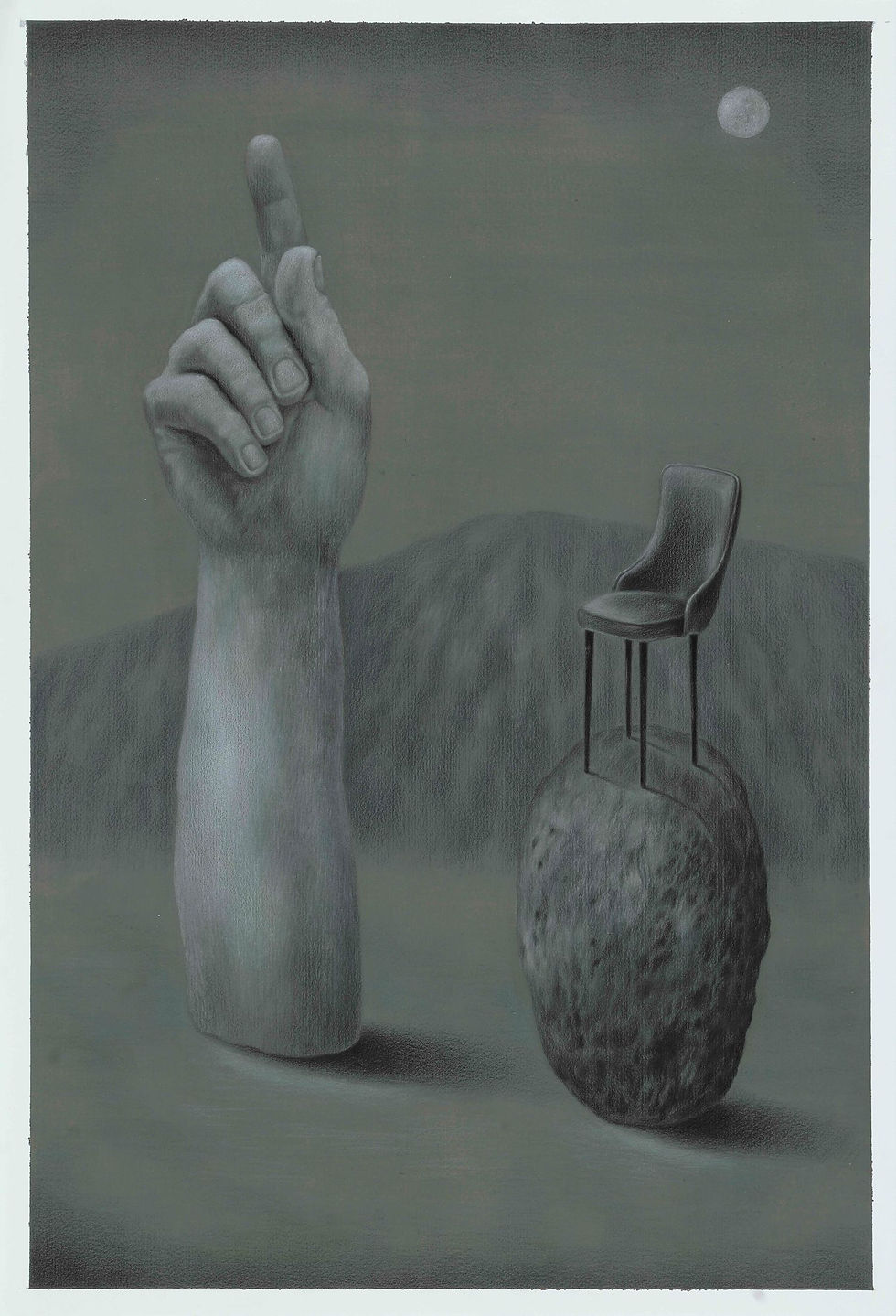
Massimo Scolari, Caspar David Friedrich cerca il Riesengebirge, 1979

The paintings on view evoke metaphysical visions populated by towers, wings, fortresses, pyramids, stormy seas, and mountains—worlds devoid of human figures yet charged with “waiting.” As Daniele Del Giudice once wrote: “the object is there, but as a silent aftermath… an imitation of truth.” Alongside the canvases, a selection of pen drawings blends imagination with architectural rigor, revealing the technical precision that defines his artistic language.


The exhibition journey is enriched by photographs of Scolari’s installations captured by Luigi Ghirri, Gabriele Basilico, and Luca Campigotto, as well as publications and rare editions, including On Drawing, a book of aphorisms and sketches translated by James S. Ackerman. The show is accompanied by a catalog published by Grafiche Antiga, featuring texts by Scolari, Del Giudice, and Léon Krier.


Shiota Chiharu, Accumulation - Searching for the Destination 2014/2019
Massimo Scolari, Turris Babel, 1981

With works held in collections such as MoMA, the Centre Pompidou, and the Tehran Museum of Contemporary Art, and an academic path spanning Harvard, Yale, and IUAV, Scolari returns to Milan with an exhibition that does not celebrate the past, but reactivates it—as myth, form, and destiny.


Antonia Jannone Disegni di Architettura

Corso Garibaldi 125 – Milano


Date

19 novembre 2025 - 24 dicembre 2025


MACBA inaugurates its thirtieth anniversary with Project a Black Planet. The Art and Culture of Panafrica, an ambitious exhibition that places the global reach of Pan-Africanism back at the center of the conversation.


Shiota Chiharu, Uncertain Journey, 2016/2019
Views of the exhibition "Project a Black Planet: The Art and Culture of Panafrica", 2025. Photo: Miquel Coll

Curated by Elvira Dyangani Ose, Antawan Byrd, Adom Getachew, and Matthew S. Witkovsky, the exhibition runs until 6 April 2026 and proposes a historical and critical journey through one hundred years of cultural, political, and artistic practices.


More than five hundred objects — artworks, documents, posters, books, recordings, and popular media materials — trace the impact of Pan-Africanism on the sociopolitical transformations of the twentieth century and beyond: from the World Wars to the Spanish Civil War, from anti-colonial struggles to civil rights movements. In this installation, documentary testimony stands on equal footing with artistic production: posters, newspapers, and pamphlets hold the same interpretive value as paintings or installations.


The project is the result of an international collaboration involving the Art Institute of Chicago, the Barbican Centre in London, KANAL–Centre Pompidou in Brussels, and MACBA. After its premiere in Chicago, the exhibition arrives in Barcelona — inaugurated with a curatorial conversation on 5 November — and will later travel to the Barbican in 2026. Each stop reshapes the presentation by integrating new archives and local perspectives.


Philip Guston If This Be Not I 1945 Mildred Lane Kemper Art Museum. Univerity purchase, Kende Sale Fund, The Estate of Philip Guston, courtesy Hauser & Wirth
Views of the exhibition "Project a Black Planet: The Art and Culture of Panafrica", 2025. Photo: Miquel Coll

At MACBA, the exhibition is enriched by three previously unseen archival collections: materials that reveal early-twentieth-century interpretations of Africa and the diaspora; the extensive archive of the Chimurenga platform; and the Pan African Orogeny archival project by Tania Safura Adam, which connects Pan-African histories with the contemporary history of Spain and Catalonia. Of particular significance is the reconstruction of Black presences in 1930s Barcelona — artists, intellectuals, and communities that gathered around jazz and boxing — underscoring the city’s long-standing role as a crossroads of Black internationalism.


The exhibition organizes its materials into thematic clusters — from Garvey and the building of autonomous Black worlds, to Négritude, quilombismo, and spiritual and performative practices — offering a transnational and transhistorical map of interlinked struggles and imaginaries. The accompanying publication, Pan-Africa. Art and Political Imaginaries for the Construction of a Black Planet, expands the interpretive lens with historical texts and contemporary reflections.


Shiota Chiharu, Accumulation - Searching for the Destination 2014/2019
Views of the exhibition "Project a Black Planet: The Art and Culture of Panafrica", 2025. Photo: Miquel Coll

Project a Black Planet is not merely a retrospective: it is an invitation to rethink global history through the cultural practices of the African diaspora. At MACBA, the exhibition becomes a tool to reread the past and reimagine a shared future, reminding us that Pan-Africanism is a living, plural, and deeply urgent movement today.


MACBA Museu d’Art Contemporani de Barcelona

Plaça dels Àngels, 1


Date

6 novembre 2025 - 6 Aprile 2026


From 12 November 2025 to 3 January 2026, Pavilions 9a and 9b host a dual exhibition project that reflects on identity, fracture, and the possibility of recomposition: Armonia 5.0. Allorché di due farete Uno by Otello Scatolini, curated by Claudio Strinati, and The Shapes of Humanity by Keisuke Matsuoka, curated by Tomoko Asada.


Shiota Chiharu, Uncertain Journey, 2016/2019
Otello Scatolini, Androgino, 2015

Two independent paths, yet driven by the same question: how can the human be recomposed in an age of dispersion? Scatolini, born in Rome in 1964, has worked on this challenge for over fifteen years, shaping marble, resin, lead, gold and pigments into an alchemical equilibrium of forces. His sculpture does not occupy space: it breathes it. His monumental forms feel hydraulic, liquid, suspended.


The material is heavy, yet behaves like water. The title Armonia 5.0 suggests an evolutionary software update of humankind: no longer a dichotomy, but a fusion of opposites. The conceptual emblem of the exhibition is Androgino (2015), a hybrid figure inspired by the Vitruvian Man, projected into the 21st century— a body-synthesis that does not divide, choose, or separate, but incorporates. Nearby, Uovo Cosmico (2005) embodies the archetype of origin: art as a generative act, healing, primordial magic.


A powerful section is dedicated to writing: poured in lead, carved in gold, embedded in paintings or absorbed into sculpture, it appears as a secret language, an indecipherable murmur. Titles such as Grida e sussurri (Cries and Whispers) or Mo(a)rmorio overturn the noise of the present into meditation: the word does not communicate, it vibrates. It does not shout, it resonates. For the first time, visitors will be able to enter the artist’s mental studio through 3D viewers—an immersive experience in the act of creation, guided by Scatolini himself through special performative tours.


Philip Guston If This Be Not I 1945 Mildred Lane Kemper Art Museum. Univerity purchase, Kende Sale Fund, The Estate of Philip Guston, courtesy Hauser & Wirth
 Keisuke Matsuoka, dettaglio Rifugiato cielo, 2022

In Pavilion 9a, Keisuke Matsuoka, born in Miyagi in 1980, reverses the perspective. If Scatolini seeks unity, Matsuoka begins with explosion. His sculptures burst, fragment, and reassemble into forms that do not deny the wound, but transform it into structure. In Refugee Gravity, an ebony face dismantles into shards mapped across the wall: an exploded identity that becomes landscape.


In A tree man, a magnetic body made of wood, iron and titanium gathers metallic dust like a living organism, demonstrating that identity is a field of forces, attraction and loss. The Refugees cycle—developed during his residency in Italy—does not address geographical borders, but inner ones: being a refugee not as a geopolitical condition, but as the universal, potential destiny of any individual.


Matsuoka works with glass, wax, titanium, iron, wood and magnets—materials that dissolve, attract, migrate, reconfigure. His creative process, both material and conceptual, mirrors nature’s own rhythm: to create, destroy, and remake. In the final room, sketches, diaries, molds and test prints allow the audience to inhabit the artist’s studio, to perceive the friction of making, the error as form, and metamorphosis as method.


Shiota Chiharu, Accumulation - Searching for the Destination 2014/2019
 Keisuke Matsuoka, A tree man, 2018

The overall exhibition thus becomes a diptych of the contemporary condition: on one side, the tension toward unity; on the other, awareness of fracture. I


Mattatoio di Roma

Piazza Orazio Giustiniani, 4


Date

11 novembre 2025 - 12 gennaio 2026


bottom of page